Article Key Words

Flies in your Eyes is a dynamic source of uncommon commentary and common sense, designed to open your eyes and stimulate your thinking.

grid detail
Showing posts with label Hiking physiology. Show all posts

Sunday, September 15, 2013

Stairmastering


 Hornli Hut, Switzerland - photo by JoAnn Sturman

Scott Sturman

“If you can read a book or make sense of a television program while exercising on the Stairmaster, then you’re not working hard enough.” 
-- W.R. Priskna

Once again it is time to head to the local gym and hop on the Stairmaster to prepare for the next trek.  In front of my machine a bank of television screens broadcasts sports, news, and ABC.  The management makes certain both FOX and CNN are displayed, so each political party can dispense their verse of Pravda equally to all exercisers.  But the carefully tabulated programming bias does not take into account the political leanings of non news programs, and ABC’s The View is a good example of the insidious nature political indoctrination masked as entertainment.  Today, viewers are treated to another provocative show from the ABC affiliate of the Barrack Obama Fan Club, as the hostesses contemplate the President’s favorite movie or extol his extraordinary breath of talent and insight.  There’s sure to be a riveting interview of some brain-dead guest from the entertainment industry, who Joy, Barbara, Whoopi, and Sheri will cajole into repeating the talking points of the DNC. 

But enough of that and back to exercising.  On either side of me on adjacent Stairmasters are two Spandex clad athletes both with their eyes pasted to the television and their legs moving furiously in a piston-like motion.  My concern is not the disbelief of two adults enthralled by low brow propaganda, but the manner in which they use the machine.  To impress themselves or fellow gym rats, both are maxed out at level 20 and face forward during their entire routine.  The man to my left is bent over 90 degrees at the waist with his body draped over the handrails, while the woman on the right stands erect with her arms pronated 180 degrees, elbows locked, and each hand clasping the rail.  Neither is breathing particularly hard or dripping with perspiration which allows them to capture every uttered nuance on the television.  Perhaps the ease of effort has something to do with their legs having to support less than half of their body weight.

To get the most out of a Stairmaster workout, one should learn to use it without relying on arm support.  Exercising in this manner for an extended time at even moderate levels of resistance requires balance and extreme cardiovascular endurance, but the real test is the ability to walk the stairs sideways, backwards, side to side, two at a time, and in 360 degree circles.  All techniques require one to stand up straight, just as one should do when hiking.  Sideways steps teach one place the foot flat on the step, thus minimizing the use of muscles of the lower leg, which can lead to fatigue on demanding terrain.  Walking backwards strengthens the hamstrings and helps prevent posterior knee pain common when hiking downhill.  The side to side step teaches one to face up the hill and move the legs laterally across the path to take advantage of optimum footing.  Double steps strengthen the extensor muscle groups of the hip and thigh, and although Small Steps are recommended when ascending a trail, it is helpful to have the capability to take large vertical steps.  The last maneuver, where one turns in full circles both clockwise and counter clockwise without arm support, requires both agility and balance and is sure to catch the attention of gym patrons–a valuable technique for the single crowd.

Soaked in sweat and glad to be nearly done with my work out, I glance up at The View and can’t help but think these moo moo dressed stars, who make of big deal of losing ten pounds but forget gaining twenty, should keep their hands out of the cookie jar.  As William Randolph Hearst used to quip, “Rules are only for the small people.”       

Monday, September 2, 2013

Small Steps on the Haute Route

Mt. Blanc - photo by JoAnn Sturman

Scott Sturman

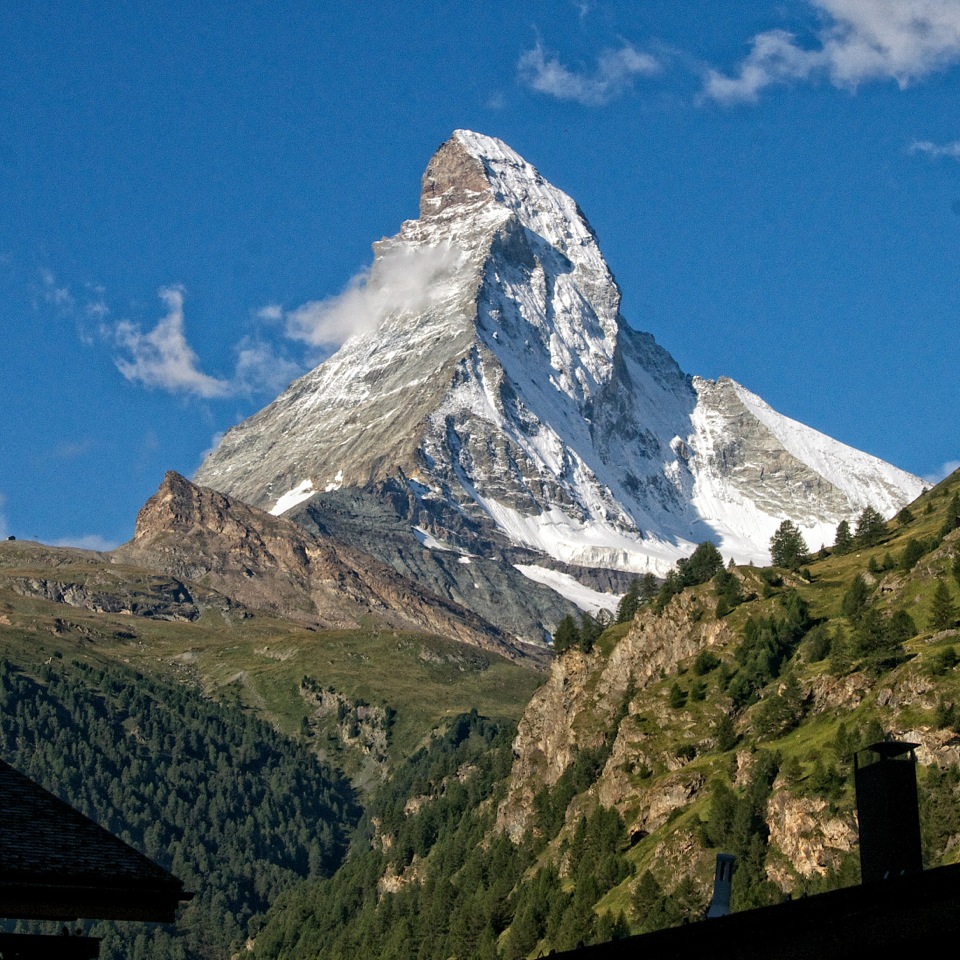
The Haute Route or High Route runs from Chomonix, France near Mount Blanc through Switzerland to Zermat, which rests at the base of the Matterhorn.  Nearly the entire course is a above tree line with magnificent mountain views and alpine meadows filled with flowers exhibiting a riot of colors.  For the most part the trek is a series of 6-8 hour hikes over excellent trails which take one from one valley and over a steep 9000 to 10,000 foot pass or col then down to the adjoining valley.  The vertical ascent on each of the ten consecutive hiking days averages about 3000 feet but some days is closer to 4000 feet.  Hikers carry a day pack weighing from 15-30 pounds and sleep eight nights in a hotel or on the remaining two in improved huts high above the valley floor.  It is not uncommon for participants to be well past 50 years old, which was the case in our group which ranged from the mid 50’s to the upper 60’s.


Haute Route - photo by JoAnn Sturman


On flat terrain and at moderate altitudes it’s possible to carry on a conversation with an experienced guide, but on steep inclines or at high altitudes it soon becomes a one way conversation.  As a guide continues to talk effortlessly, the client finds that even yes and no responses provoke shortness of breath.  It’s always best to ask the guide open ended questions and grunt one’s approval every so often to prevent any interruption of oxygen delivery to heart and legs.

Weather permitting, on the last day of the Haute Route, one has the option of climbing to the Hornli Hut at 10,700 feet on the northeast ridge of the Matterhorn.  I was walking with our lead guide and world class mountaineer, Dan Windham, and as the terrain became progressively steeper my conversation lapsed into one syllable words.  


Ibex on Haute Route - photo by JoAnn Sturman


“Follow me and let me show you some techniques which will improve your efficiency under these conditions,” he offered.  “First of all, your steps are too long.  Given the choice between one eight inch vertical step or two four inches ones, take the latter.  A big step will interrupt your breathing as you strain to lift yourself to the next level.  Stand up straight, and on steep ground let the bones rather than the muscles of the leg support your weight.  It’s also a good idea to climb using the large muscle groups of your upper leg and hip rather than the lower leg.  If you face directly up the hill and push off with the ball of the foot, the calf muscles quickly fatigue.  I often turn a few degrees to either side, so I can place my foot flat on the ground and use the proper muscle groups.”

I tried the short, quickened steps and felt much better and could at least carry on some semblance of a conversation.  His points made sense physiologically.  At high levels of exercise the match between ventilation and cardiac output are critical.  If one strains to negotiate a high step, it is impossible to maintain minute ventilation and a fleeting but unwanted Valsalva maneuver may occur which retards blood returning to the heart.  The next step will feel twice its actual height.  


Reaching the Coll - photo by JoAnn Sturman

As one tires, there is tendency to slump forward making it difficult to expand the lower segments of the lung, contributing to ventilation-profusion mismatch.  Dan’s posture was erect and occasionally during expiration he pursed his lips to provide positive end expiratory pressure to the lungs.  “I have been able to attain higher than expected oxygen saturation levels at extreme altitude using this technique,” he remarked.

The recommendation to use the bones of the legs to support one’s weight as the other leg prepares to strike the ground is reminiscent of the Sherpa Step technique described by Gary McCue in Tibet.  It was discussed in a previous article The Sherpa Step.  Over large distances and on steep slopes the benefits are considerable. 


Matterhorn from Zermat - photo by JoAnn Sturman

The small quick steps remind me of the native porters in the Andes, who are able to carry heavy loads and never seem to lose their balance.  Whether going up or downhill their feet move quickly but never very far at a time.  Long powerful strides up the mountain look impressive, but when the day is done little steps are more efficient and minimize those gasping breaths, which make any guide wonder if one can speak in complete sentences.


Matterhorn from Hornli Hut - photo by JoAnn Sturman


grid detail