Harvest Time Near the Great Wall of China - photo by JoAnn Sturman
Scott Sturman
fliesinyoureyes.com
On the back roads near the Great Wall north of Beijing, farmers heaped large piles of soy beans with the crop still attached to dried leaves and stems. Any passing vehicle was obliged to run over or through the five foot high mound which helped separate the beans from the chafe. It must have provided the farmers immense amusement and punctuated their dreary days to see our car careen through their makeshift barricade. Their’s was a difficult life. At the time in 2007, 56% of China’s 1.3 billion people lived in rural areas, but per capita income was only one-third of urban dwellers. Success meant leaving the countryside and moving in droves to China’s already crowded cities.
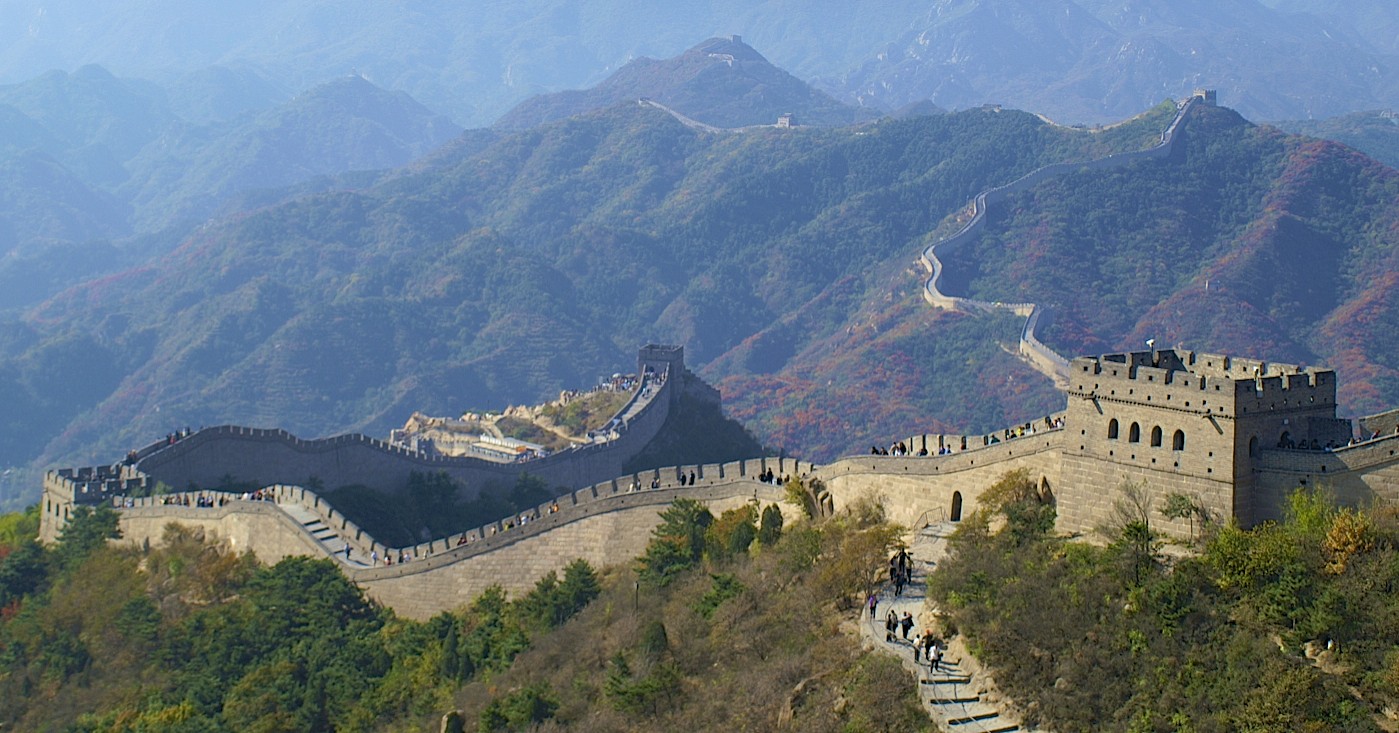
Great Wall of China - photo by JoAnn Sturman
With the exception of these few extra days hiking and driving in the vicinity of the Great Wall, my wife’s and my trip to China would be considered the standard pilgrimage. In this case under the watchful eye of our tour guide, the affable chain smoking “Henry,” who like others in his profession had majored in tourism while attending college and had a knack for taking his tour group to shop at every silk, rug, and cloisonné factory in the country.
At this time in the autumn of 2007 the country was in a frenzy preparing for the 2008 Summer Olympic Games to be held in Beijing. Like most foreigners, we were exposed to a highly sanitized, staged view of the rebirth of a nation, one where Communist overlords relaxed doctrinaire economic restraints which had kept the country tightly controlled since Mao’s rise to power in 1949. Despite the trip’s orchestration, one could not help but be impressed by the energy of the Chinese worker and the impressive display of public work projects, but it did not require a particularly fastidious observer to realize these gains came at a price. China’s meteoric rise had been built on cheap labor, production unfettered by environmental or social welfare concerns, and an under valued yuan.
Tiananmen Square - photo by JoAnn Sturman
While seated in our tour bus stuck in stop and go traffic, I spotted a small red disc directly overhead and asked JoAnn, “Is that the sun?” Normally, one is used to seeing this phenomena at dusk or dawn as the sun’s rays strain to penetrate the earth’s atmosphere tangentially, but this was noon on a cloudless day in Beijing. The smog was so acrid and dense it made the Los Angeles air of the 1970s seem like Lake Tahoe. Despite the congestion and pollution, bicycles outnumbered cars by a staggering margin. As China’s prosperity increased and bicyclists became motorists, the air quality was not going to improve.
Beijing's Olympic Stadium avec Smog - photo by JoAnn Sturman
From the capital we flew to Xian, home of the Terra Cotta Warriors. The air was thick with smoke from farmers burning fields and factories belching fumes, and the reason wearing a surgical mask was popular in this country where the sun never seemed to shine. The Warriors were built in the third century B.C. and meant to protect China’s first emperor Qin Shi Huang in the afterlife. The effort embodied the Chinese infatuation with grandiose public works projects and required the labor of an estimated 700,000 slaves compelled to construct a sanctuary for a man known for his extreme cruelty and caprice. Soon after his death, a peasant insurrection led to the destruction and burial of the mausoleum. It is one matter to rule in life but quite another to do so after death.
Terra Cotta Warriors - photo by JoAnn Sturman
As the airliner descended, the coal fire haze obscured Chongqing, a bustling megalopolis of 28,000,000 on the Yangtze River, and the point of embarkation for the 410 mile cruise down the river to the Three Gorges Dam. Throughout the voyage we peered through the smokey air toward the shore and observed ubiquitous signs on either side the gorge indicating their precise elevation, for when the reservoir was filled its surface would be precisely 175 meters above sea level. To avoid the rising water, 1.3 million people were either displaced or moved to entirely new villages higher up the steep hills bordering the Yangtze. It was as if all the inhabitants of San Antonio or San Diego or Dallas were forcibly moved and required to leave their homes and possessions to the advancing waters. When it comes to engineering and massive construction, there is no such thing as human rights in the People’s Republic.
Sun and Yangtze River - photo by JoAnn Sturman
A 600 mile flight from Wuhan, which is just downstream from the Three Gorges Dam, took us to Guilen in the southern China. The area is known for its beautiful limestone karsts along the Li River, but the more vivid memory recalls the little Chinese girls dressed in pink accompanied by their newly adoptive American parents. No boys were going to America, just those troublesome girls who happened to be born under the state mandated one-child-per-couple program. The preference for boys may have a strong cultural underpinning, but in a generation a substantial number of this great surplus of grown men will be sleeping with each other.
Limestone Cavern near Guilen - photo by JoAnn Sturman
The last leg of the trip concluded with an 800 mile flight to Shanghai to witness the culmination of the Chinese success story. The old European buildings along the Bund adjacent the Huangpu River were dwarfed by newly constructed skyscrapers festooned with garish light displays. The energy and wealth of the region were palpable. All that was needed was to tweak the Workers' Paradise, and the superiority of communism with a conscience became readily apparent.
Despite the fanfare, the story seemed too good to be true. In a country just as choked for space as for clean air, individual freedom was as rare as good health ("The Sick Man of Asia") and concern for the environment. Prosperity was coming to China, but the Bill of Rights was not along for the trip. And what about the rumors of human rights violations and martial law in Tibet far to the West and away from the media’s prying eyes?


 Connect with us on Facebook