Article Key Words

Flies in your Eyes is a dynamic source of uncommon commentary and common sense, designed to open your eyes and stimulate your thinking.

grid detail
Showing posts with label Sherpa Step. Show all posts

Monday, September 2, 2013

Small Steps on the Haute Route

Mt. Blanc - photo by JoAnn Sturman

Scott Sturman

The Haute Route or High Route runs from Chomonix, France near Mount Blanc through Switzerland to Zermat, which rests at the base of the Matterhorn.  Nearly the entire course is a above tree line with magnificent mountain views and alpine meadows filled with flowers exhibiting a riot of colors.  For the most part the trek is a series of 6-8 hour hikes over excellent trails which take one from one valley and over a steep 9000 to 10,000 foot pass or col then down to the adjoining valley.  The vertical ascent on each of the ten consecutive hiking days averages about 3000 feet but some days is closer to 4000 feet.  Hikers carry a day pack weighing from 15-30 pounds and sleep eight nights in a hotel or on the remaining two in improved huts high above the valley floor.  It is not uncommon for participants to be well past 50 years old, which was the case in our group which ranged from the mid 50’s to the upper 60’s.


Haute Route - photo by JoAnn Sturman


On flat terrain and at moderate altitudes it’s possible to carry on a conversation with an experienced guide, but on steep inclines or at high altitudes it soon becomes a one way conversation.  As a guide continues to talk effortlessly, the client finds that even yes and no responses provoke shortness of breath.  It’s always best to ask the guide open ended questions and grunt one’s approval every so often to prevent any interruption of oxygen delivery to heart and legs.

Weather permitting, on the last day of the Haute Route, one has the option of climbing to the Hornli Hut at 10,700 feet on the northeast ridge of the Matterhorn.  I was walking with our lead guide and world class mountaineer, Dan Windham, and as the terrain became progressively steeper my conversation lapsed into one syllable words.  


Ibex on Haute Route - photo by JoAnn Sturman


“Follow me and let me show you some techniques which will improve your efficiency under these conditions,” he offered.  “First of all, your steps are too long.  Given the choice between one eight inch vertical step or two four inches ones, take the latter.  A big step will interrupt your breathing as you strain to lift yourself to the next level.  Stand up straight, and on steep ground let the bones rather than the muscles of the leg support your weight.  It’s also a good idea to climb using the large muscle groups of your upper leg and hip rather than the lower leg.  If you face directly up the hill and push off with the ball of the foot, the calf muscles quickly fatigue.  I often turn a few degrees to either side, so I can place my foot flat on the ground and use the proper muscle groups.”

I tried the short, quickened steps and felt much better and could at least carry on some semblance of a conversation.  His points made sense physiologically.  At high levels of exercise the match between ventilation and cardiac output are critical.  If one strains to negotiate a high step, it is impossible to maintain minute ventilation and a fleeting but unwanted Valsalva maneuver may occur which retards blood returning to the heart.  The next step will feel twice its actual height.  


Reaching the Coll - photo by JoAnn Sturman

As one tires, there is tendency to slump forward making it difficult to expand the lower segments of the lung, contributing to ventilation-profusion mismatch.  Dan’s posture was erect and occasionally during expiration he pursed his lips to provide positive end expiratory pressure to the lungs.  “I have been able to attain higher than expected oxygen saturation levels at extreme altitude using this technique,” he remarked.

The recommendation to use the bones of the legs to support one’s weight as the other leg prepares to strike the ground is reminiscent of the Sherpa Step technique described by Gary McCue in Tibet.  It was discussed in a previous article The Sherpa Step.  Over large distances and on steep slopes the benefits are considerable. 
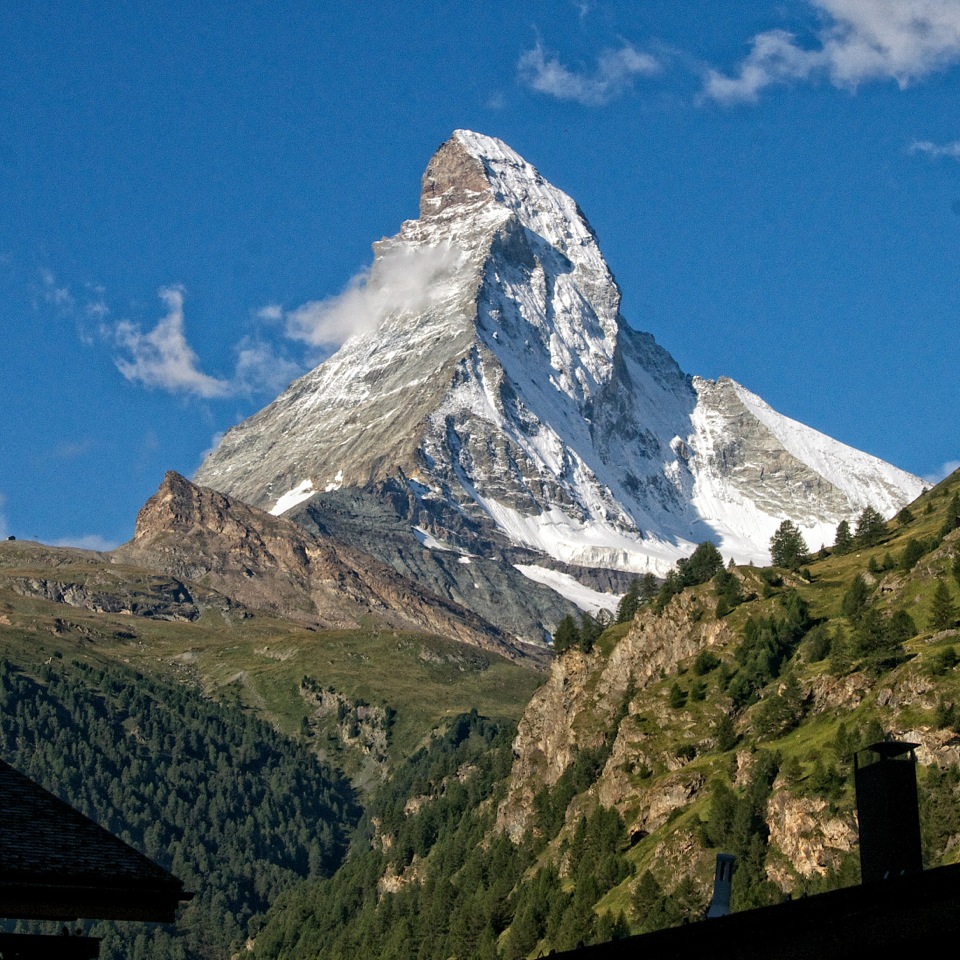


Matterhorn from Zermat - photo by JoAnn Sturman

The small quick steps remind me of the native porters in the Andes, who are able to carry heavy loads and never seem to lose their balance.  Whether going up or downhill their feet move quickly but never very far at a time.  Long powerful strides up the mountain look impressive, but when the day is done little steps are more efficient and minimize those gasping breaths, which make any guide wonder if one can speak in complete sentences.


Matterhorn from Hornli Hut - photo by JoAnn Sturman


Friday, September 14, 2012

The Sherpa Step


Scott Sturman
fliesinyoureyes.com

Yaks and Mt. Shishapangma - photo by JoAnn Sturman

Rick Hoffman, a high school friend, wrote a five part story in Flies In Your Eyes entitled “Climbing Aconcagua.”  In the series he recounts his and his son Mark’s adventures climbing the Western Hemisphere’s highest mountain carrying heavy packs in blizzard conditions and then saving a fellow climber’s life in the middle of the night. Rick aptly observed a vigorous lifestyle and advancing age are not mutually exclusive.


My wife and I had the opportunity to travel in Tibet this year with a premier guide, Gary McCue, who has been adventuring in the country since 1985 and wrote the definitive book about trekking in the region, Trekking Tibet: A Traveler’s Guide.  We were members of Wilderness Travel’s Highest Trek in the World group, whose goal was to walk to Mt. Everest’s Camp 3 at 21,100 feet.  With the exception of an exceptional teenager, our group ranged in ages from the early 50s to 70.  To our surprise, this was the youngest group Gary had led on this particular trek, and although no technical mountaineering skills were required, there was a considerable amount of huffing and puffing along the way.

Trekking in Tibet - photo by JoAnn Sturman

The Sherpas, native Nepalese mountain people, who are known for their physical prowess at extreme altitude, hike up steep hills in a distinctive style called the Sherpa step.  It is a particularly useful technique for saving energy when carrying heavy loads up inclines where there is little oxygen in the air.  Normally, we walk with our knees slightly bent throughout the range of motion.  On flat ground the body’s weight is supported primarily by the bones of the leg, but steeper slopes require more muscle involvement to overcome gravity and stabilize joints when the advancing leg is positioned forward of the center of gravity.  The knee and hip of the leg in contact with the ground never completely straighten and force the muscles of the hip, thigh, and calf to be in a nearly constant state of contraction when ascending steep grades.  

To take advantage of skeletal support when walking up substantial gradients, the Sherpas put a subtle hitch in the leg in contact with the ground.  They rarely stoop when walking and keep the upper body more or less erect.  As the front leg moves forward, the rear one completely straightens for an instant, causing the upper body to sway backwards ever so slightly.  This allows the femur and tibia to bear the body’s weight while the surrounding muscles relax.  Over many hours and up thousands of feet, using bones rather than muscles for support provides a huge benefit.  Observing the Sherpas glide over the mountain trails, prompted members of the group to mimmic their gait, and although there will never be a Tenzing Norgay among us, there was a decided benefit at the end of the day. 

On Mount Kilimanjaro guides instruct hikers to walk “pole, pole” or slowly, slowly which is sufficient to get many to the top, but in the Himalayas where trekking requires participants to cover long distances as well as negotiate long ascents and descents, technique as well as speed are important.  The Sherpas are so fit and acclimatized, that is seems their pace is the same whether climbing up or down a mountain, and I wonder if they walk “pole pole” even when approaching Everest’s summit. 

Altitude sickness is the bane of the high altitude trekker, and one wrongly assumes an episode at much lower altitudes necessary means problems at loftier elevations.  In all cases where I have experienced severe altitude sickness, I ascended much too fast under taxing conditions or thought I could drive from my near sea level home one day and scamper up to 13,000 or 14,000 feet the next.  Headache, fatigue, nausea, and ataxia were the inevitable results until I heard about the bicarbonate wasting diuretic acetazolamide.       

With a better understanding of physiology and well planned itineraries utilizing a “camp low, hike high” regimen, experienced mountain guides are adept at leading white haired, Medicare aged clients safely to impressive altitudes.  Good physical conditioning is a must, but judicious use of acetazolamide (Diamox) to hasten the acclimatization process and acetaminophen for treating high altitude headaches has allowed clients who are accustomed to sea level conditions to ascend to altitudes near 20,000 feet with few ill effects.  In most cases the traditional Diamox dose of 250 mg twice a day can be halved.  Climbers should begin two days prior to ascent and continue until summiting.  Adequate fluid intake is essential to compensate for dry air and high energy consumption rates associated with steep terrain, cold weather, and low oxygen tensions.  Generally, frequently watering the ground with copious volumes of clear colored urine insures sufficient hydration.

“If you can’t carry on a normal conversation while trekking then you’re walking too fast,” Gary advised.  This was possible up to a certain incline and altitude, but there was a point where talking interfered with breathing even at a snail’s pace.  I learned to ask Gary open ended questions, so he would talk most of the time, and I could add to the conversation with an occasional grunt.  When approaching one’s physiologic limit, it was better to shut up and slow way down to keep the respiratory and heart rates in a tolerable zone.  It is remarkable how quickly the heart rate accelerates and shortness of breath occurs, when one goes beyond the comfort zone and climbs a little too fast.

Trekking in Tibet - photo by JoAnn Sturman

There is no reason for seniors or anyone else to condemn themselves to ocean cruises, puttering around the garden, or spending the weekend watching television.  With a savvy guide and adequate physical preparation, the world of National Geographic is no longer just accessible to 20 and 30 year old somethings.     
grid detail